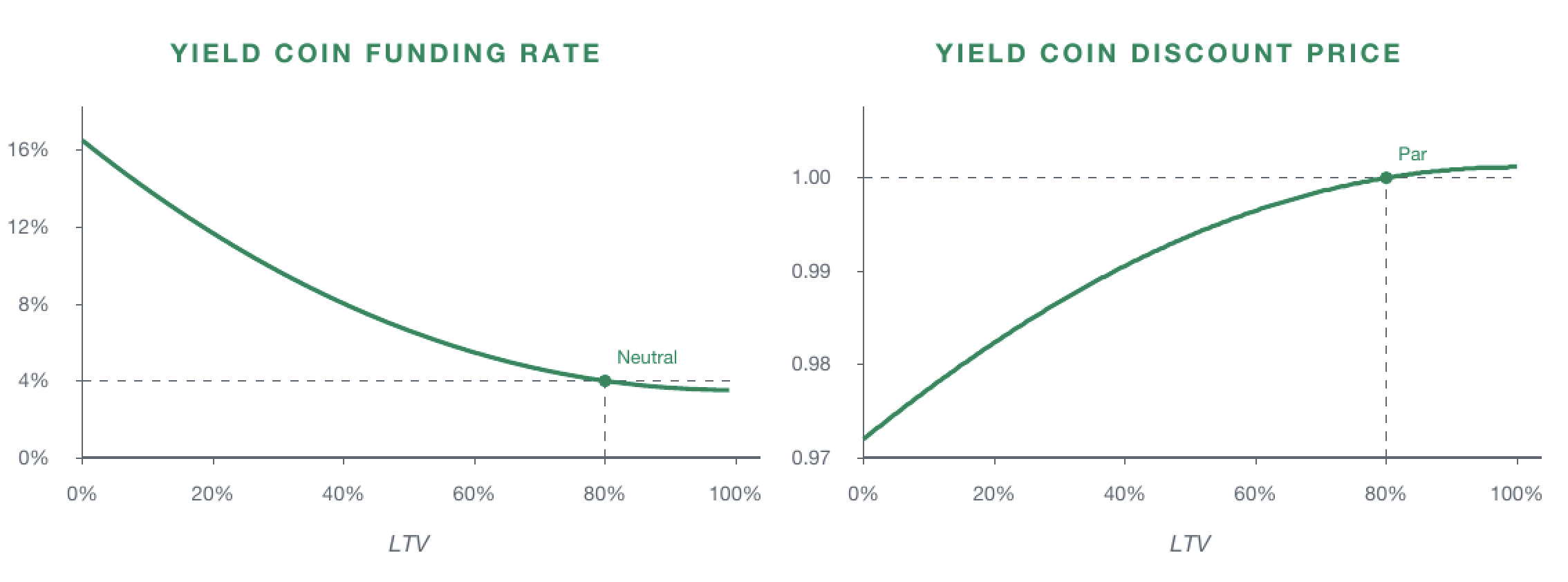
Funding rate and Yield Coin discount price as a function of LTV, for the 80/20 Concentrated market type.
\left(L/\sqrt{P_a} -V_Y\right)\left(L\sqrt{P_b} - V_L \right)=L^2,
L=\frac{\sqrt{P_aP_b}}{\sqrt{P_b}-\sqrt{P_a}}V_B
Where: * $$V\_Y$$ = NAV (notional) of **Yield Coins**; * $$V\_L$$ = NAV of **Leverage Coins**; * $$V\_B$$ = NAV of the **Base Asset** collateral pool; * $$P\_a, P\_b$$ = price band parameters that concentrate liquidity within a defined range. The Latent Swap AMM clears each tranche at a market price relative to its NAV. The Yield Coin trades at a discount to NAV (its discount *is* the implied funding rate); the Leverage Coin's price relative to its NAV moves with leverage demand. The price band parameters `Pa` and `Pb` are fixed at market deployment and define the range over which the Yield Coin price can move; they concentrate liquidity within that range and bound the implied funding rate at the corresponding extremes. ## Value conservation The invariant is **homogeneous of degree one**: scaling both tranche positions and the collateral pool by the same factor leaves the curve unchanged (each side scales identically). A direct consequence — Euler's identity for a degree-one homogeneous function — is that the **market values of the two tranches always sum to the collateral value**, at every LTV and not only at Neutral LTV:V_B = p_Y\,V_Y + p_L\,V_L
where $$p\_Y$$ and $$p\_L$$ are each tranche's market price relative to its NAV (the prices the AMM sets above). In words: the Latent Swap never creates or destroys value; it only re-divides a fixed collateral pool between the senior and junior claims as LTV moves. The clean NAV identity $$V\_B = V\_Y + V\_L$$ on the [How tranching works](/protocol-mechanism/how-does-covenant-work.md) page is the special case at Neutral LTV, where $$p\_Y = p\_L = 1$$. This is a solvency property by construction: because the curve can only partition the collateral — never inflate the sum of the claims against it — a Covenant Market is fully backed at every point on the curve, with no path by which the AMM itself manufactures an uncovered claim. ## LTV is the input variable Covenant defines the loan-to-value of a market as Yield Coin NAV divided by Base Asset NAV: $$ LTV = \frac{V\_Y}{V\_B} $$ Effective leverage on the Leverage Coin is `1 / (1 - LTV)`. The Latent Swap AMM prices Yield Coins and Leverage Coins as a continuous function of LTV, so changes in LTV move tranche prices and the implied funding rate together. ## Self-balancing The Latent Swap invariant makes Covenant Markets self-balancing without external rebalancing or governance: * **When LTV falls** (high Leverage Coin demand, low Yield Coin supply), Yield Coin prices fall, the implied rate rises, and new lenders are drawn in, pushing LTV back up. * **When LTV rises** (low Leverage Coin demand, abundant Yield Coin supply), Yield Coin prices rise, the implied rate compresses, lender appetite cools, and Leverage Coin demand returns, pushing LTV back down. The diagram below illustrates this for the [80/20 Concentrated](/markets/market-types/80-20-concentrated.md) market type (`Neutral LTV = 80%`, `Pa = 0.97`, `Pb = 1.00`, `D = 3 month perpetual`, Neutral rate \~4%). The left curve shows the implied funding rate as a function of market LTV; the right curve shows the Yield Coin's discount price against NAV at the same LTV.Funding rate and Yield Coin discount price as a function of LTV, for the 80/20 Concentrated market type.